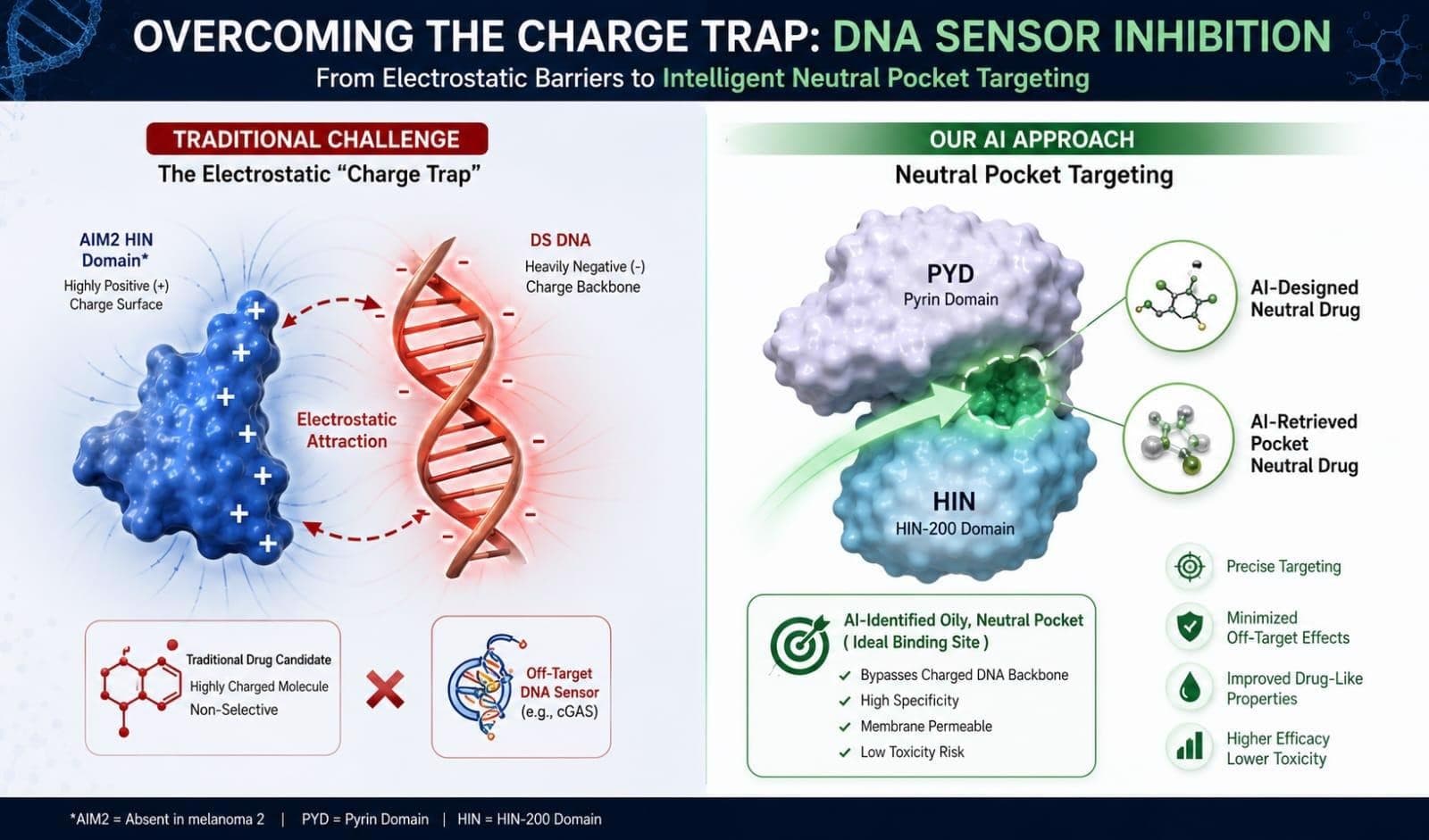
For over a decade, the Absent in Melanoma 2 (AIM2) inflammasome has represented one of the most promising, yet frustratingly elusive, targets in immunology. While universally recognized as a primary driver of autoinflammatory pathologies, metabolic diseases, and neurodegenerative disorders, pharmaceutical development has stalled. Traditional drug discovery pipelines have consistently failed to drug AIM2 due to the “Electrostatic Charge Trap”—a biophysical paradox that forces traditional competitive inhibitors to mimic the dense negative charge of double-stranded DNA (dsDNA), resulting in toxic, non-permeable compounds.
Consequently, AIM2, while heavily researched in academia, is currently not being actively pursued in commercial clinical pipelines.
Enter Q-RETIX.AI. By deploying our proprietary structural AI discovery matrix, we have completely reimagined the approach to AIM2 inhibition. Rather than competing at the highly charged orthosteric active site, Q-RETIX.AI mapped the dynamic conformational landscape of the AIM2 protein to uncover a hidden, hydrophobic cryptic pocket within the interdomain hinge. The result is the computational design of a first-in-class, uncharged, lipophilic small-molecule modulator that selectively immobilizes AIM2 in its basal autoinhibited state.
This report outlines the scientific architecture of the AIM2 target, the historic bottlenecks that halted its pursuit, and how Q-RETIX.AI is reviving this multi-billion dollar therapeutic opportunity.
Executive Summary
Q-RETIX.AI has computationally designed a first-in-class, uncharged, lipophilic small-molecule modulator targeting AIM2. By moving away from competitive orthosteric inhibition at the highly charged HIN-200 dsDNA binding site, our platform identified a previously undocumented hydrophobic cryptic pocket in the interdomain hinge. The resulting allosteric molecular wedge immobilizes AIM2 in its basal autoinhibited state, bypassing the Electrostatic Charge Trap entirely and reigniting a dormant therapeutic target.
1. The AIM2 Paradox: A Critical Node in Innate Immunity
The innate immune system relies on pattern recognition receptors (PRRs) to act as the first line of defense, detecting danger-associated or pathogen-associated molecular patterns. Among these, AIM2 stands out as a critical cytosolic sensor belonging to the PYHIN (HIN-200) family. Its primary function is to detect aberrant cytosolic dsDNA—a universal danger signal indicative of viral infection, bacterial invasion, or severe genomic instability.
Structural Topography of the Basal Autoinhibited State
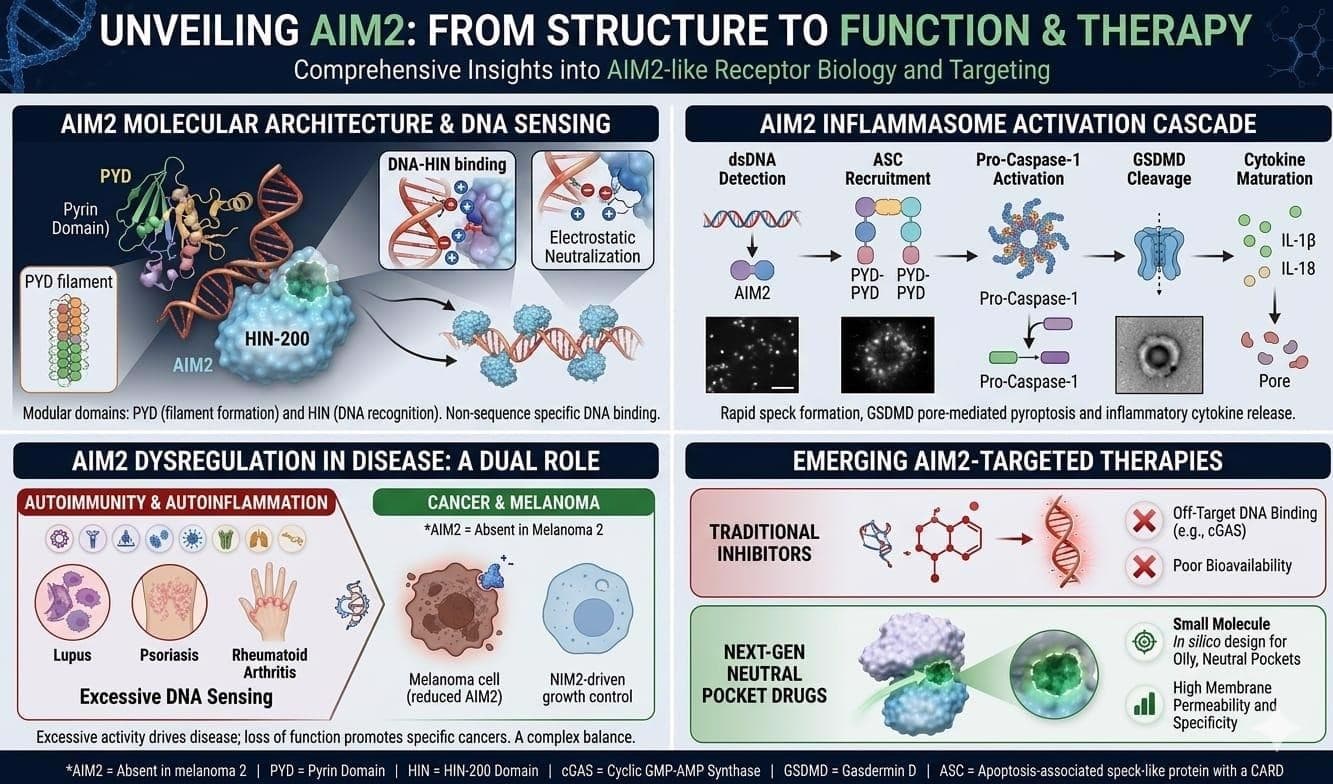
Human AIM2 is an elegant, bipartite molecular machine consisting of two primary domains connected by a flexible 15-amino-acid hinge:
- The N-Terminal Pyrin Domain (PYD):Spanning residues 1-94, the PYD acts as the signaling hub. It possesses a canonical six-helix death-domain fold characterized by an asymmetric charge distribution. The α1 and α2 helices harbor dense negative charges, while the opposite face is basic, facilitating homotypic polymerization during activation.
- The C-Terminal HIN-200 Domain: Spanning residues 138-343, this domain features tandem OB-folds heavily enriched with lysine and arginine residues. This creates a highly basic, positively charged surface optimized for binding non-sequence-specific nucleic acids (dsDNA).
In a healthy, resting cell, AIM2 is transcriptionally silent. It maintains a basal, autoinhibited configuration stabilized by an intramolecular electrostatic equilibrium between the PYD and the HIN-200 domains. This delicate lock prevents premature inflammasome activation and unintended cellular destruction.
Figure 1: Comprehensive Insights into AIM2-like Receptor Biology and Targeting, detailing the molecular architecture, activation cascade, and the dual role of AIM2 dysregulation in disease.
The Pathological Activation Cascade
When the PYD-HIN lock is broken, the consequences are severe. Dysregulation of AIM2, specifically excessive DNA sensing, drives severe autoimmune and autoinflammatory conditions, including Systemic Lupus Erythematosus (SLE), Psoriasis, and Rheumatoid Arthritis.
The activation involves a dramatic macromolecular cascade:
- Ligand Engagement: Cytosolic dsDNA outcompetes the intramolecular PYD-HIN bond.
- Filament Nucleation: The flexible hinge rotates, exposing the PYD. Monomers rapidly stack to form massive filamentous structures.
- ASC Speck Assembly & Pyroptosis:The PYD filament recruits ASC adapter proteins, forming an “ASC Speck.” This activates Pro-Caspase-1, which aggressively cleaves interleukins (IL-1β, IL-18) and Gasdermin D (GSDMD), culminating in pore-mediated pyroptosis (inflammatory cell death).
2. The Traditional Bottleneck: The Electrostatic “Charge Trap”
Given its role in severe autoimmune diseases, inhibiting AIM2 should be a primary objective for pharma. However, the industry has largely abandoned the target. Why? The answer lies in the Electrostatic Charge Trap.
Traditional rational drug design focuses on competitive, orthosteric inhibitors—molecules designed to block the active site where the natural ligand binds. In the case of AIM2, the natural ligand is the highly negatively charged backbone of dsDNA, which binds to the highly positive basic patch on the HIN-200 domain.
To outcompete dsDNA, traditional drug candidates have been engineered as highly anionic (negatively charged) molecules. This electrostatic arms race created two insurmountable pharmacological barriers:
1. The Permeability Penalty
Highly charged molecules violate Lipinski's Rule of Five. The dense anionic nature required to bind the HIN domain effectively prevents these traditional drug candidates from crossing the hydrophobic lipid bilayer of the cell membrane. If a drug cannot enter the cytosol, it cannot reach AIM2, rendering it therapeutically useless in vivo.
2. The Pan-Sensor Cross-Reactivity Risk
Even if permeability issues could be mitigated, mimicking the universal structure of the dsDNA backbone introduces severe toxicity risks. The innate immune system contains multiple distinct DNA sensors, most notably Cyclic GMP-AMP Synthase (cGAS). Orthosteric AIM2 inhibitors invariably bind to the basic patches of cGAS and other sensors. This pan-sensor cross-reactivity triggers catastrophic off-target immunotoxicity, making these compounds far too dangerous for clinical trials.
Because of this paradox—needing a heavy charge for efficacy, but a neutral profile for safety and delivery—AIM2 was shelved.
3. Enter Q-RETIX.AI: Redefining Target Discovery
Where traditional high-throughput screening and orthosteric modeling failed, Q-RETIX.AI succeeded.
The Q-RETIX platform does not merely look at static, crystallized snapshots of target proteins. Our Structural AI Discovery Matrix models the dynamic thermodynamic ensembles of proteins in real-time, scanning for transient, cryptic pockets that exist outside of known active sites.
We instructed the Q-RETIX engine to bypass the HIN-200 dsDNA binding face entirely and search for allosteric modulation points capable of stabilizing the autoinhibited monomeric state.
Discovery of the Hydrophobic Interdomain Hinge Node
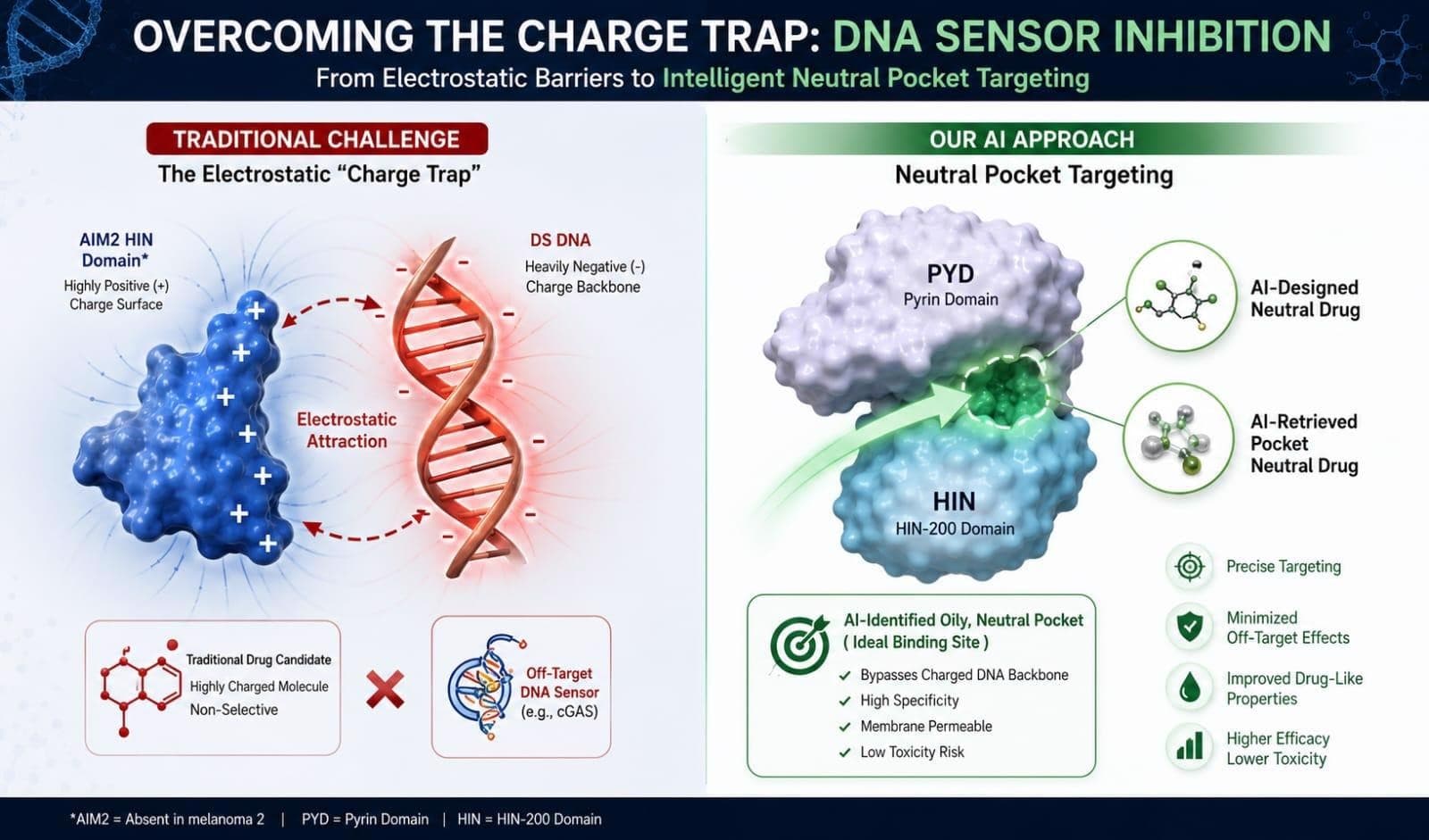
The AI identified a previously undocumented, non-polar junction within the flexible 15-amino-acid hinge connecting the PYD and HIN domains. Unlike the highly charged external surfaces of the protein, this deep interdomain node is distinctly hydrophobic (oily) and structurally neutral.
Figure 2: The Electrostatic Charge Trap vs. The Q-RETIX.AI Approach. By abandoning the highly charged DNA binding site in favor of an AI-identified neutral pocket, Q-RETIX enables high-specificity, high-permeability therapeutics.
The Allosteric Molecular Wedge
Leveraging this discovery, Q-RETIX computationally generated a novel class of therapeutic molecules. Instead of acting as an orthosteric mimic of DNA, the new drug acts as an Allosteric Molecular Wedge.
This next-generation drug candidate is an uncharged, lipophilic small molecule. It slips perfectly into the hydrophobic hinge pocket identified by the AI. Once engaged, it creates a web of hydrophobic interactions that artificially strengthen the PYD-HIN bond.
By locking the hinge, the molecule effectively immobilizes AIM2 in its basal, autoinhibited configuration. Even when vast quantities of cytosolic dsDNA flood the cell, the AIM2 monomer cannot undergo the conformational liberation necessary for PYD exposure and filament nucleation.
By breaking the energetic linkage of filament assembly at the hinge, Q-RETIX successfully halts the inflammasome cascade at step zero.
4. Comparative Pharmacology: A Paradigm Shift in Drug Design
The pharmacological advantages of the Q-RETIX allosteric architecture over traditional orthosteric mimics are profound. Our candidate completely reverses the historic liabilities associated with AIM2 targeting.
| Pharmacological Metric | Traditional Orthosteric Mimics | Q-RETIX.AI Allosteric Architecture |
|---|---|---|
| Target Domain Face | Basic HIN-200 patch | Hydrophobic interdomain hinge pocket |
| Net Charge | Highly Anionic (-) | Neutral |
| Polar Surface Area | Extremely High | Low (Lipophilic) |
| Mechanism of Action | Competitive displacement of DNA | Allosteric hinge stabilization |
| Membrane Permeability | Severely Restricted | Highly Efficient |
| cGAS / Off-Target Selectivity | Poor (Pan-sensor binding) | Excellent (Hinge-specific) |
| Clinical Toxicity Risk | High | Low |
As outlined in the comparative data above, the Q-RETIX molecule possesses ideal drug-like properties. Its neutral, lipophilic nature ensures rapid, efficient penetration of the cellular membrane. Furthermore, because the interdomain hinge pocket is unique to AIM2's specific geometry (unlike the universal DNA-binding traits of HIN domains), the Q-RETIX compound completely ignores cGAS and other nucleic acid sensors.
5. Reviving a Dormant Multi-Billion Dollar Market
By solving the biophysical roadblock that halted AIM2 research, Q-RETIX.AI is not just introducing a new drug; it is opening an entirely unexploited vertical in immunology.
Because the broader pharmaceutical industry deemed AIM2 "undruggable" due to the charge trap, the competitive landscape is currently sparse. Q-RETIX holds a first-mover advantage in a target biology that is unequivocally validated by human genetics and pathology.
Target Indications
The successful inhibition of the AIM2 inflammasome via our allosteric hinge modulator has immediate therapeutic implications for massive patient populations suffering from:
- Systemic Autoimmunity: Downregulating AIM2 directly curtails the excessive DNA-sensing feedback loops characteristic of Systemic Lupus Erythematosus (SLE) and Rheumatoid Arthritis.
- Autoinflammatory Dermatoses:Psoriasis and related skin pathologies heavily rely on AIM2-driven IL-1β and IL-18 maturation. Blocking ASC speck assembly provides a direct, upstream intervention compared to current biologic therapies.
- Metabolic & Neurodegenerative Disorders: Emerging data links chronic AIM2 activation to sterile inflammation in atherosclerosis and select neurodegenerative conditions. An orally bioavailable, highly permeable inhibitor opens the door to treating the chronic inflammatory components of these systemic diseases.
(Note: While AIM2 acts as a tumor suppressor in certain cancers—giving rise to its namesake "Absent in Melanoma 2"—Q-RETIX's precise, titratable allosteric inhibition allows for the careful management of the immune response, focusing exclusively on autoimmune overactivity without permanently ablating baseline function.)
6. Conclusion: The Power of AI in Structural Biology
The story of AIM2 is a testament to the limitations of traditional drug discovery and the transformative power of Q-RETIX.AI.
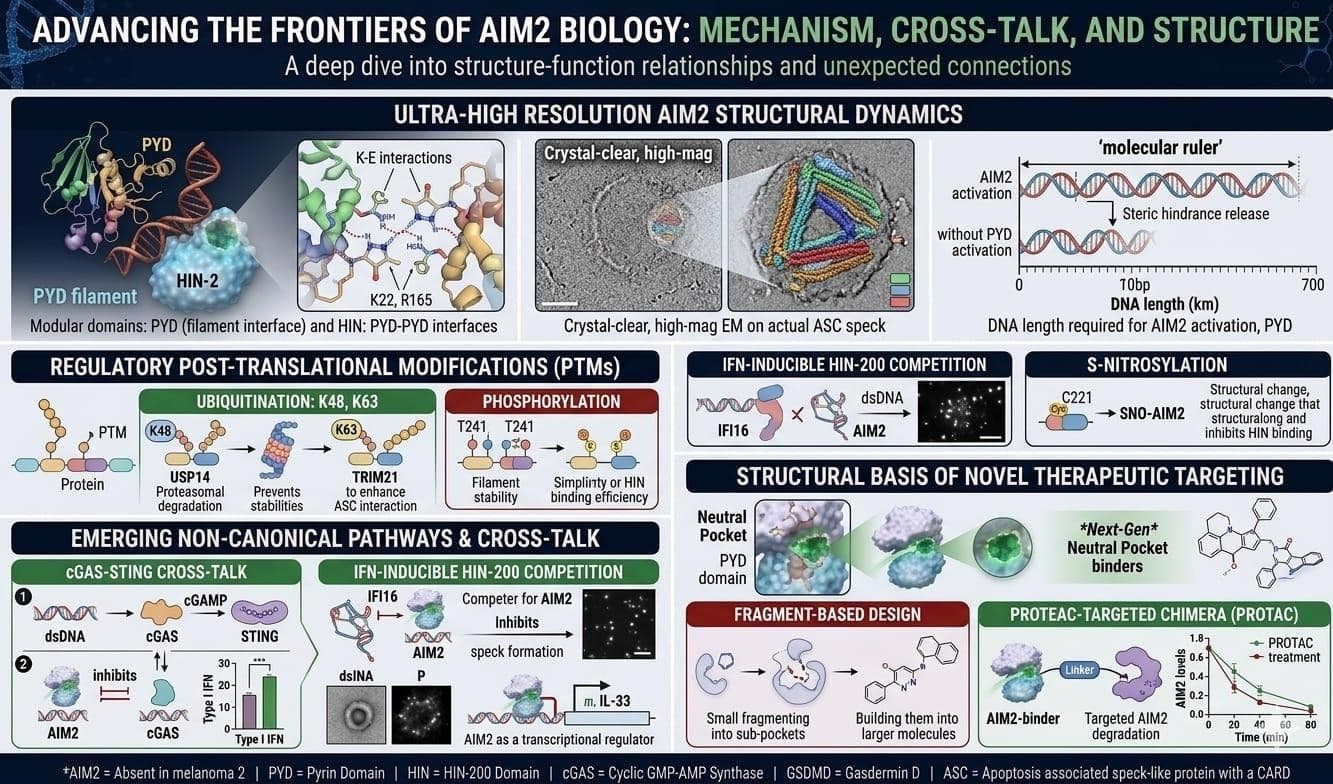
When human intuition and standard biochemical assays encountered the impenetrable Electrostatic Charge Trap, pharmaceutical development ceased. By shifting the computational focus away from the obvious, highly charged active sites, Q-RETIX discovered a protected interdomain junction that fundamentally alters how we can control protein function.
Our AI-driven design achieves what was previously thought impossible: high specificity and high membrane permeability in a DNA sensor inhibitor. This success not only yields a highly lucrative, first-in-class asset for autoimmune disease but also establishes Q-RETIX.AI as the definitive platform for unlocking the industry's most challenging, dormant therapeutic targets.
Q-RETIX has cracked the AIM2 code. The inflammasome can finally be stopped.